
1 USD to INR History (1947–2026): Year-by-Year Exchange Rates
By: TradeUCare Team
Explore the complete history of 1 USD to INR from 1947 to 2026. View year-by-year exchange rates, historical charts, and key economic events that shaped the Indian Rupee.
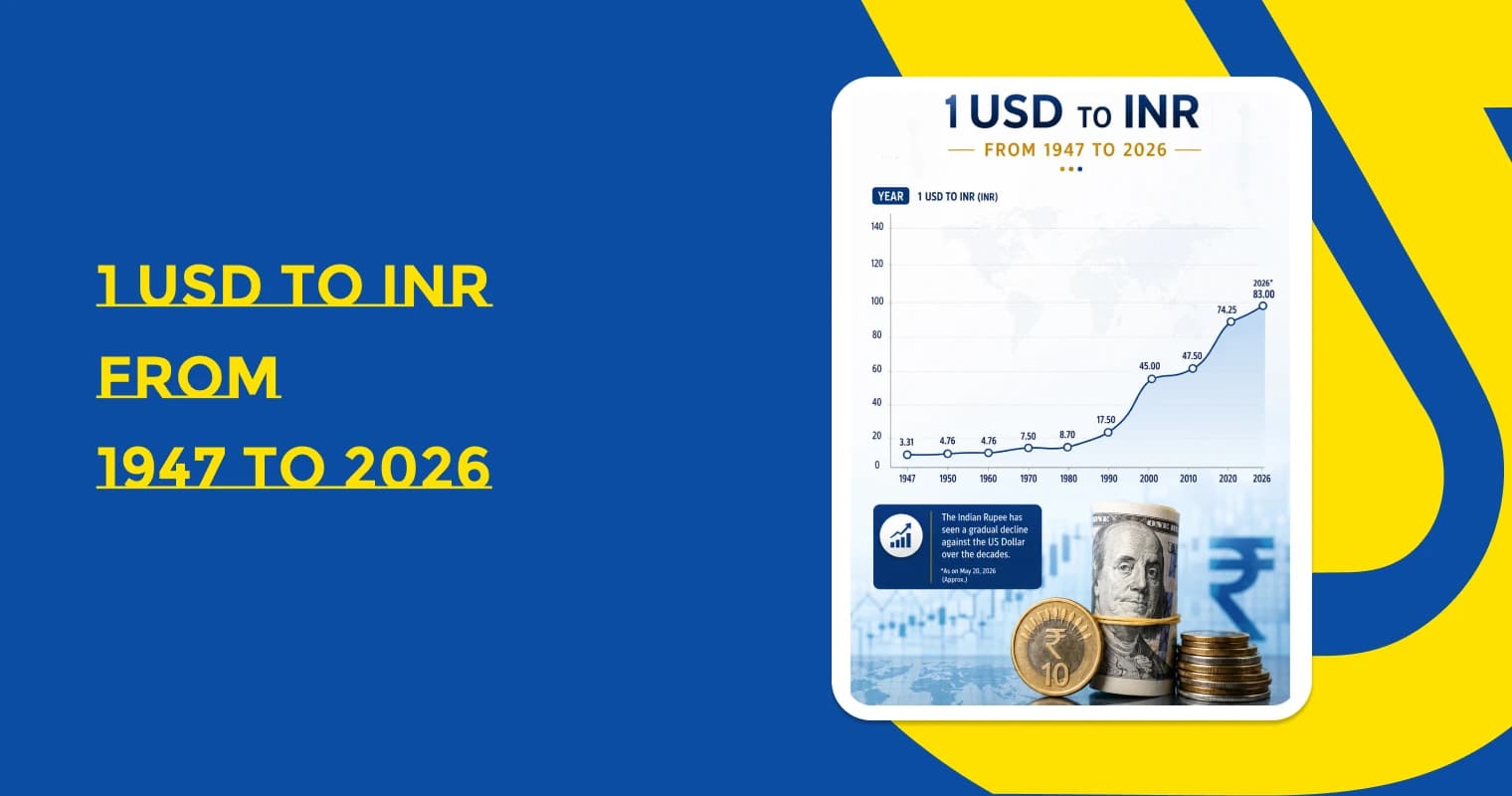
Key Takeaways
- When India gained its independence, one US dollar could purchase ₹3.32 worth of Indian rupees, but not ₹1 worth of the rupee.
- India maintained its pre-independence monetary system linked to the value of sterling upon gaining independence.
- There were major devaluations of the Indian rupee in 1949, 1966, and twice in 1991.
- India adopted a market-based exchange rate regime during the economic reforms of the early 1990s.
- The exchange rate of the Indian rupee went above ₹40 against the US dollar in the 1990s, ₹60 in the 2010s, and ₹80 in the 2020s.
- The rising USD-INR exchange rate cannot be used to suggest that India is under economic growth. The exchange rate can be influenced by a number of variables such as inflation differential and trade.
Introduction
There have been various disparities regarding the exchange rate of Indian rupee against US dollars after India achieved its independence. The exchange rate of ₹3.32 per dollar in 1947-48 escalated even more and reached ₹90 per dollar in 2026.
This phenomenon is caused by a number of causes and not only one particular cause. These causes include the change in the exchange rate policy of India, inflation, foreign currency reserve, import of oil, balance of trade, world crisis, interest rate, and international demand of US dollar.
In the coming paragraphs, one will learn about the history of 1 USD to INR Rates From 1947 to 2026.
A Quick Look at the Journey of USD and INR
The exchange rate fluctuation from 1 USD to INR from 1947 to 2026 demonstrates different phases through which Indian exchange rate policy has passed and grown.
There have been roughly four phases of exchange rate of Indian rupee:
- 1947 to the mid-1960s: There was a fixed exchange rate system in India against the pound sterling.
- 1966 to the early 1990s: Rupee underwent devaluation and was managed with reference to a basket of currencies.
- 1991 to the late 1990s: The changes introduced in the exchange rate management system followed a market-oriented approach.
- 2000 to date: The rupee began to follow the managed float regime, which was market-oriented with interventions from RBI when needed to avoid extreme volatility.
Not all the time, the exchange rate shows a certain pattern. At times, rupee has appreciated, and the reasons for that have been good investments from abroad in India, increase in exports, fall in price of oil, and weak dollar abroad. On the long-term basis, it has depreciated due to higher inflation in India than the USA, imports, and continuous demand for foreign currency.
The Beginning: 1947 and the Parity Myth
It is often said that the value of 1 rupee was equivalent to 1 US dollar at the time India gained its independence. Historical evidence refutes this claim.
RBI documents indicate an approximate exchange rate of ₹331.75 for USD 100 in the period of 1947-48. Hence, the exchange value of 1 dollar was around ₹3.32.
India did not have a completely new exchange-rate regime right after gaining its independence. It carried forward the old rupee and coinage system, and the rupee remained tied to the British pound by the sterling area agreement.
Thus, the rupee-dollar exchange rate was based on the value of the rupee relative to sterling and the pound-dollar exchange rate. Therefore, ignoring this aspect while making a comparison between rupee and dollar leads to a flawed conclusion.
In September 1949, there was a devaluation of the pound sterling with respect to the dollar. As a result, India also devalued its rupee, resulting in an approximate rupee-dollar exchange rate of ₹4.76.
Hence, it is a myth that India started as a country with a strong INR at one rupee per dollar. However, the rupee did have a better exchange value compared to its current value.
1966: The First Major Devaluation
India officially devalued the rupee on 6th June 1966. The devaluation led to the depreciation of the rupee by about 36.5% to the point where the exchange rate moved from approximately ₹4.76 to ₹7.50 to a dollar.
Some of the economic reasons that led to the devaluation include:
- Problems with the balance of payments
- Insufficient foreign exchange reserve
- Excessive imports
- Poor performance in exports
- Expenses of defense following the wars in 1962 and 1965
- Drought problems and pressure on food availability
- Reliance on international financial aid
One aim of the devaluation was to improve the competitiveness of Indian exports and relieve some pressure. A depreciated rupee leads to cheap Indian products for the foreign buyer, although the effects depend on the production capabilities of India, demand and costs at home.
While the devaluation solved some of India's external economic problems, others such as agricultural problems, dependence on imports and structural constraints still remained in influencing economic performance.
Following the breakdown of the Bretton Woods fixed exchange rate system in the early 1970s, India eventually tied its currency to a basket of currencies and not sterling alone.
1991: Liberalisation and the "New" Rupee
India was suffering from a balance-of-payments problem by 1991. The foreign exchange reserve had depleted to an extent where there were enough reserves to cover the cost of import of essentials for a short period only.
There were many reasons for this balance-of-payments problem:
- The presence of a substantial fiscal and current account deficit
- Increasing level of foreign debt
- Increasing costs of crude oil due to the Gulf crisis
- Slow pace of export growth
- Limited availability of external borrowing
- Loss of confidence among the investors and creditors
In July 1991, the rupee underwent devaluation in two phases. The total depreciation was around 18% relative to the US dollar.
The exchange rate rose from roughly ₹21 to ₹25-₹26 after the adjustment. But more importantly, India started changing its whole foreign exchange regime.
There were two exchange rates under the Liberalised Exchange Rate Management System in 1992. Foreign exchange revenues were partially exchanged at an official rate, while the remaining were exchanged at market rate.
In 1993, the two exchange rates were merged to form a market-based exchange rate. In 1994, convertibility in current account took place.
It does not imply that the RBI was not part of the currency market. A managed floating system was adopted in India, under which market forces determine the exchange rate, while the intervention by the RBI keeps things orderly.
The 2000s to Now: A Steady Climb
The rupee started in the new decade of 2000 with an exchange rate of approximately ₹44-₹45 to a dollar. Since then, the movement of the rupee has been one of depreciation and appreciation.
In the mid-2000s, the Indian economy was growing rapidly, thus boosting the rupee. The rupee appreciated sharply in 2007 but depreciated in 2008 due to the global financial crisis.
These included the following:
- Global financial crisis of 2008: Capital outflows and risks of investments caused depreciation of emerging market currencies.
- Taper tantrum of 2013: Speculation regarding the cut in monetary support of the United States' Federal Reserve caused capital outflows from many emerging economies such as India.
- 2016-2018: High prices of oil, strong dollars and changes in the capital flow created pressures on the rupee.
- Pandemic period of 2020: Risks in financial markets and uncertainties in the economy raised the demand for the dollar.
- Starting from 2022: Increase in US interest rates, geopolitical risks, high cost of energy imports and risks globally continued to pressurise the rupee.
- 2025-2026: The rupee remained under pressure from oil prices, foreign investment flows, conditions of international trade and general movement in the US dollar.
Crude oil requirements in India are largely met through imports. Oil being priced in dollars, higher prices of oil increase the foreign exchange requirements of India.
1 USD to INR: A Quick Overview
The table presents selected milestones rather than every annual rate. Values before 2026 are approximate annual or period averages drawn from historical datasets. The 2026 figure is an indicative June market reference and may change daily.
| Year | Approximate INR per USD | Important Context |
|---|---|---|
| 1947-48 | ₹3.32 | Rupee remained linked to sterling after Independence |
| 1949 | ₹4.76 | Rupee devalued after sterling devaluation |
| 1966 | ₹7.50 | Major official devaluation |
| 1975 | ₹8.97 | Managed exchange rate linked to a currency basket |
| 1980 | ₹7.86 | Period of relative appreciation against the dollar |
| 1985 | ₹12.37 | Gradual depreciation during the 1980s |
| 1990 | ₹17.50 | External imbalances were increasing |
| 1991 | ₹22.74 | Balance-of-payments crisis and two-stage devaluation |
| 1993 | ₹30.49 | Unified market-determined exchange rate introduced |
| 2000 | ₹44.94 | Rupee had crossed ₹40 during the late 1990s |
| 2005 | ₹44.10 | Foreign investment and growth supported the rupee |
| 2010 | ₹45.73 | Recovery after the global financial crisis |
| 2013 | ₹58.60 | Taper-tantrum pressure and capital outflows |
| 2015 | ₹64.15 | Stronger dollar and changing global conditions |
| 2020 | ₹74.10 | Pandemic-related market and economic stress |
| 2022 | ₹78.60 | US rate increases and geopolitical uncertainty |
| 2023 | ₹82.58 | Rupee remained above ₹80 per dollar |
| 2024 | ₹83.67 | Continued pressure from global dollar and trade conditions |
| 2025 | ₹85.99 | Approximate annual official exchange-rate average |
| June 2026 | Around ₹94-₹96 | Indicative market range, not a completed annual average |
Note: Historical exchange rates may be different depending on what dataset you choose because some datasets have used financial year average rates, yearly average rates, year-end rates, or a particular daily rate. The 2026 rate provided here is for reference only and varies each day.
Why Does the Dollar Keep Getting Stronger?
The rupee-dollar exchange rate depends not only on Indian economic factors but also on factors prevailing in the USA. The dollar does not appreciate every year, but there are a few factors contributing to a higher number of rupees required to purchase one dollar.
Difference in Inflation
High inflation in India in comparison with the USA over an extended period of time will likely decrease the purchasing power of the rupee relative to the dollar. The exchange rate will likely be slowly adjusted according to this difference.
Import Demand
The Indian economy imports oil, machinery, electronics, chemical products and many others. The importers have to pay in foreign currency, thus generating demand for dollars regularly.
Balance of Trade / Balance of Payments
Whenever imports exceed exports, the demand for foreign currency will likely become larger than foreign currency receipts. However, the capital inflows can compensate for that.
Interest Rate in the USA
An increase in the interest rate in the USA will attract global money to the investments in dollars and can cause outflow from developing countries.
Demand for Global Safe Havens
During a financial crisis, war, or time of uncertainties, there could be preference for liquid dollar-denominated assets which could result in appreciation of the dollar relative to many other currencies, including the rupee.
Flows of Foreign Investments
Inflows of foreign investment into Indian equities, bonds, or businesses could aid in strengthening the rupee. Outflows will have an opposite effect on the rupee.
Intervention by RBI
The RBI normally doesn't set a fixed exchange rate. It can intervene in the market through purchasing or selling foreign exchange in case there is extreme volatility.
Also, the value of the rupee should not be measured against the currency, which is the lowest-denominated currency in the world. The denomination of a currency depends upon the history, rate of inflation, monetary system, and redenomination of a currency.
Conclusion
USD-INR history is directly linked to the economic growth of India. Devaluations, foreign exchange crises, liberalisation, global economic events and the growth of international business have led to changes in the fixed sterling-based currency system.
The consistent depreciation of the currency over time does not necessarily indicate continuous economic deterioration in India. The economy of India has made huge progress in many ways; however, there are other factors influencing the exchange rate such as inflation rates, demand for imports, international money flows and the importance of the US dollar in the world.
Considering historical exchange rates, it must always be kept in mind how the calculation was done. For current travel purposes, it is always better to check the most recent live exchange rate.
FAQs
USD to INR rate keeps on fluctuating on a daily basis. As per reports in June 2026, 1 US Dollar was equivalent to around ₹94-₹96, whereas according to RBI's DBIE dashboard, an exchange rate indicator was at ₹94.35.
Search
Categories
- Currency Exchange4
- Travel Tips5
- Money Transfer3
- Forex Trading1
- RBI Guidelines1